
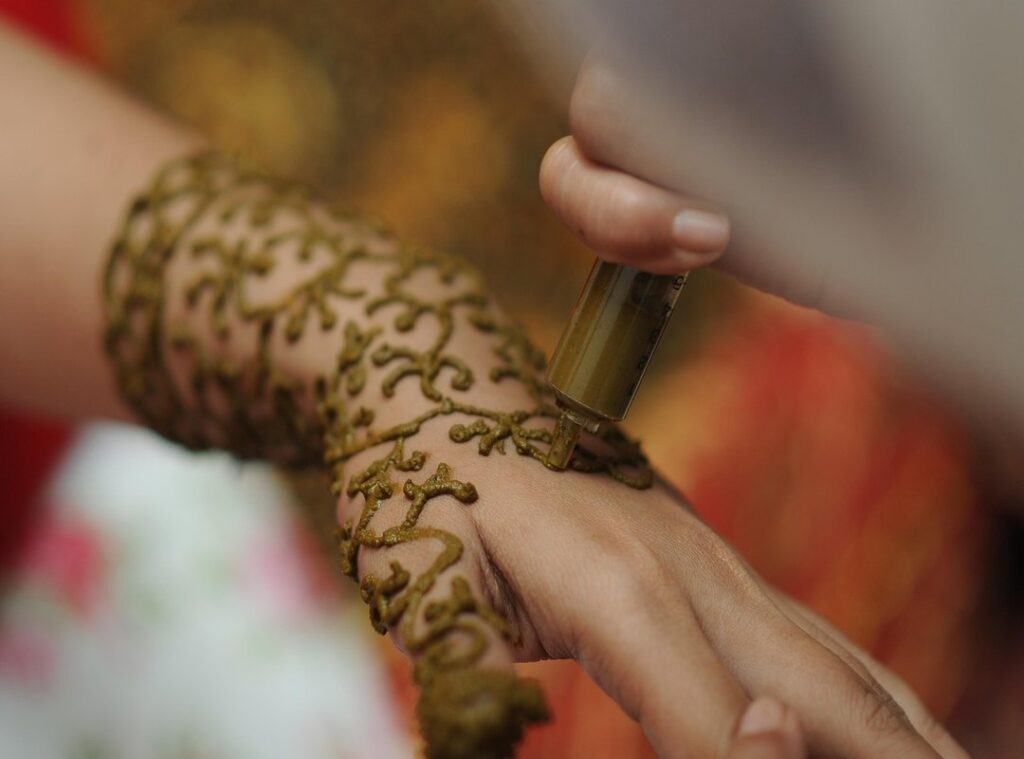
Henna art is stunning, no doubt about it. But the intricate designs can be a bit overwhelming for beginners.
That’s where inai simple cantik comes in. Simplicity in henna is not only achievable but incredibly elegant and beautiful.
This guide will give you the confidence, tools, and step-by-step instructions to create your own gorgeous henna designs at home.
You don’t need advanced artistic skills. Just a steady hand and the right techniques.
You’ll learn the key elements of simple design, what supplies you need, and tutorials for specific patterns.
Let’s get started.
The Core Principles of Simple and Stunning Henna
When it comes to henna, I firmly believe in the “less is more” philosophy. It’s all about using negative space—the empty skin—to make simple designs pop and look more professional.
Let’s break down the fundamental building blocks of easy henna designs: dots, straight and curved lines, simple leaves (teardrop shapes), and basic floral patterns (U-shaped petals). These elements are the foundation of any minimalist design.
Placement is key. A small, well-placed design on a finger, the side of the hand, or the wrist can be more striking than a large, complex piece. For example, a delicate vine wrapping around a finger, a minimalist band on the wrist, or a single small mandala in the center of the palm can create a stunning effect.
Consistency is crucial. Even with basic patterns, the key to a polished look is consistency in the thickness of lines and the size of dots. This attention to detail makes all the difference.
I’ve seen some debate about whether simpler designs are truly more impactful. Some argue that intricate, detailed work is more impressive. But in my experience, inai simple cantik often has a more lasting and elegant impact.
So, if you’re just starting out, don’t feel pressured to create overly complex designs. Focus on mastering the basics, and you’ll find that your henna looks more professional and appealing.
Your Essential Toolkit for Perfect Henna at Home
When it comes to henna, the quality of your paste is everything. I can’t stress this enough: use 100% natural, body-art-quality (BAQ) henna paste.
One of my clients once told me, “I tried black henna once, and it was a disaster.” She ended up with a nasty rash. That’s because ‘black henna’ often contains PPD, a chemical that can cause severe skin reactions. Stay away from it.
So, what do you need? Fresh, natural henna cones, rubbing alcohol or witch hazel, cotton balls, and a lemon-sugar sealant spray.
The lemon-sugar sealant spray is easy to make. Just mix 2 parts lemon juice with 1 part sugar. It helps the henna stain darker and last longer.
Cleaning the skin with alcohol removes natural oils, allowing the henna dye to penetrate more deeply for a darker stain. Simple, right?
For beginners, a few extra tools can be really helpful. Toothpicks are great for cleaning up small mistakes. Q-tips and simple adhesive stencils can give you a boost if you’re not yet confident in freehand drawing.
A friend of mine, who’s just starting out, said, “Those stencils saved me from a lot of frustration.” They help you get those clean lines without the pressure of freehand. inai simple cantik
Before you start on your skin, do a ‘test doodle’ on a piece of paper. This way, you can check the henna cone’s flow and consistency. Trust me, it makes a big difference.
And remember, inai simple cantik is all about keeping it straightforward and beautiful. Don’t overcomplicate it.
Step-by-Step Guide: 3 Easy Henna Designs to Master
Henna art is all about simplicity and elegance. Let’s dive into three easy designs that you can master with a bit of practice.
Design 1 – The Minimalist Finger Vine
First, start with a gently curving line from the cuticle down the finger. Think of it as a vine. Next, add small, teardrop-shaped leaves on alternating sides of the vine.
This gives it a natural, flowing look. Finally, finish with a trio of dots near the knuckle for balance. It’s a simple yet elegant design.
Design 2 – The Simple Wrist Cuff
Now, let’s move to the wrist. Draw two parallel lines around your wrist, like a bracelet. Fill the space between them with a simple, repeating pattern.
You can use scallops (a series of connected ‘U’ shapes) or alternating dots and dashes. This design is perfect for those who love a classic, clean look.
Design 3 – The Dainty Palm Dot Mandala
For the palm, begin with a single, bold dot in the center. Surround this with a circle of smaller dots. Add a ring of simple U-shaped petals around the dots.
Extend straight lines out from the petals, ending each with a dot. This creates a beautiful, symmetrical mandala.
Tips for Success
To keep your lines steady, anchor your drawing hand with your other hand. This prevents shaky lines and helps you maintain control.
Remember, henna art is all about practice. Start with these simple designs and gradually build up to more complex ones. With time, you’ll find your own style and create inai simple cantik that truly reflects your personality.
Pro Tips for a Darker, Longer-Lasting Stain

Aftercare is just as important as the application itself for achieving a rich, dark color.
Let’s talk about the lemon-sugar sealant. Once the henna paste is dry to the touch, lightly spritz or dab it on. This keeps the paste moist and adhered to your skin.
The ideal time to leave the paste on is a minimum of 4-6 hours. But if you want the darkest possible stain, go for overnight. Trust me, it makes a difference.
When it’s time to remove the paste, gently scrape it off using a credit card or your fingernail. Don’t wash the area with water for at least 12-24 hours. This step is crucial.
inai simple cantik means keeping it simple and beautiful. Follow these steps, and you’ll get the best results.
Start Creating Your Own Beautiful Henna Art Today
Creating beautiful henna is accessible to everyone and does not require being a professional artist. The key to success lies in starting with high-quality natural paste, mastering a few simple design elements, and following the proper aftercare steps.
Choose one of the inai simple cantik designs from the guide and give it a try without any pressure. It’s time to stop admiring and start creating. Pick up a henna cone and express your own unique style today.

 There is a specific skill involved in explaining something clearly — one that is completely separate from actually knowing the subject. Josephinia McDonaldores has both. They has spent years working with debt reduction strategies in a hands-on capacity, and an equal amount of time figuring out how to translate that experience into writing that people with different backgrounds can actually absorb and use.
Josephinia tends to approach complex subjects — Debt Reduction Strategies, Budgeting Tips and Strategies, Expense Tracking Tools being good examples — by starting with what the reader already knows, then building outward from there rather than dropping them in the deep end. It sounds like a small thing. In practice it makes a significant difference in whether someone finishes the article or abandons it halfway through. They is also good at knowing when to stop — a surprisingly underrated skill. Some writers bury useful information under so many caveats and qualifications that the point disappears. Josephinia knows where the point is and gets there without too many detours.
The practical effect of all this is that people who read Josephinia's work tend to come away actually capable of doing something with it. Not just vaguely informed — actually capable. For a writer working in debt reduction strategies, that is probably the best possible outcome, and it's the standard Josephinia holds they's own work to.
There is a specific skill involved in explaining something clearly — one that is completely separate from actually knowing the subject. Josephinia McDonaldores has both. They has spent years working with debt reduction strategies in a hands-on capacity, and an equal amount of time figuring out how to translate that experience into writing that people with different backgrounds can actually absorb and use.
Josephinia tends to approach complex subjects — Debt Reduction Strategies, Budgeting Tips and Strategies, Expense Tracking Tools being good examples — by starting with what the reader already knows, then building outward from there rather than dropping them in the deep end. It sounds like a small thing. In practice it makes a significant difference in whether someone finishes the article or abandons it halfway through. They is also good at knowing when to stop — a surprisingly underrated skill. Some writers bury useful information under so many caveats and qualifications that the point disappears. Josephinia knows where the point is and gets there without too many detours.
The practical effect of all this is that people who read Josephinia's work tend to come away actually capable of doing something with it. Not just vaguely informed — actually capable. For a writer working in debt reduction strategies, that is probably the best possible outcome, and it's the standard Josephinia holds they's own work to.