
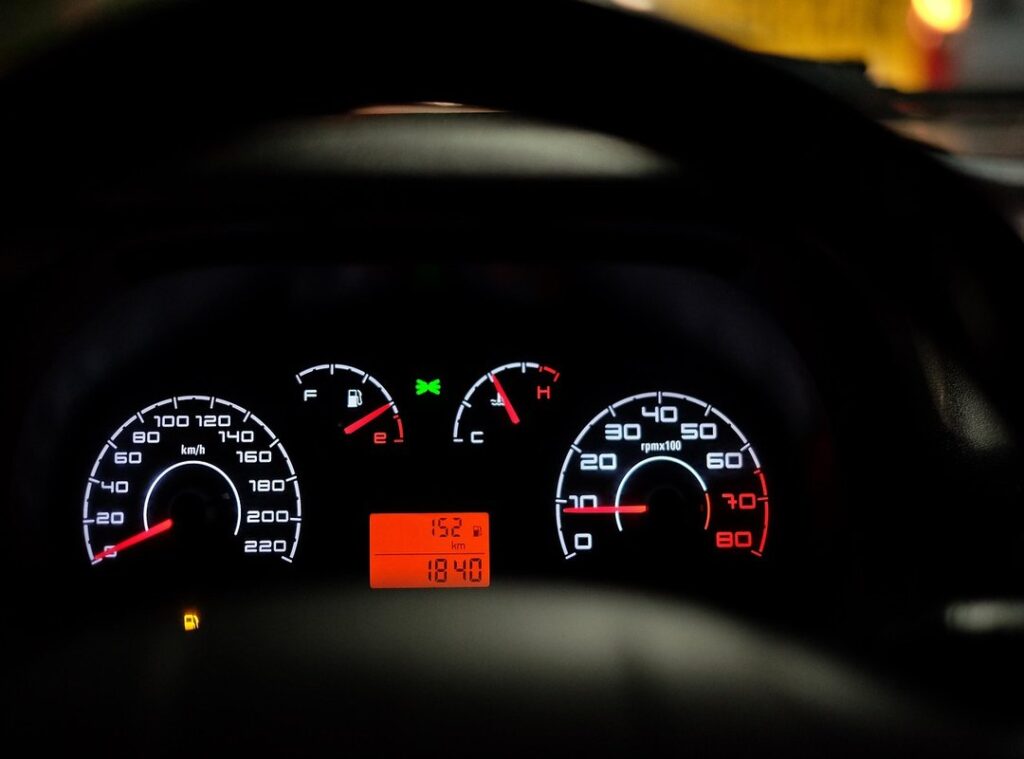
You’re watching a car review or a sports broadcast, and suddenly you see 133 mph. But what does that mean in a country that uses km/h? It’s a common question, and it can be frustrating to not know the answer.
This guide will give you the exact conversion for 133 mph to kmh and show you how to do it for any speed. No need to pull out a calculator every time.
I’ll break down the formula, give you step-by-step instructions, and even throw in some real-world examples to make it all stick. By the end of this short article, you’ll be able to convert any speed from MPH to KM/H in your head. Trust me, it’s simpler than you think.
The Quick Answer: 133 MPH is Exactly How Many KM/H?
133 miles per hour is equal to approximately 214.04 kilometers per hour.
This is the result of a standard conversion formula recognized globally. For quick estimations, a rough mental shortcut is to multiply the mph by 1.6.
| Miles per Hour (mph) | Kilometers per Hour (km/h) |
|---|---|
| 133 | 214.04 |
While having the answer is great, understanding how to get it is even better.
The Simple Math Behind Converting Miles per Hour to Kilometers per Hour
Let’s start with the basics. We’re dealing with two units of measurement: the imperial mile and the metric kilometer.
Here’s the core relationship: one mile is officially defined as exactly 1.60934 kilometers.
Now, for the conversion formula. It’s simple:
Kilometers per Hour = Miles per Hour × 1.60934.
Why does this work? When you’re converting miles per hour to kilometers per hour, you’re measuring the same duration—just one hour. So, you only need to convert the distance.
For example, if you have a speed of 133 mph, you can convert it to km/h by multiplying 133 by 1.60934.
It’s also good to know the reverse formula:
Miles per Hour = Kilometers per Hour / 1.60934.
This way, you can easily switch between the two units depending on what you need.
Understanding these formulas can save you a lot of time and confusion. Whether you’re traveling or just curious, having this knowledge at your fingertips is incredibly useful.
Calculating 133 MPH to KM/H Yourself: A Step-by-Step Guide

Let’s dive into the process, and it’s simpler than you might think.
Start with the speed you want to convert, which is 133 MPH.
Next, identify the conversion factor , and it’s 1.60934. This number feels like a magic key, doesn’t it? Aggr8Budgeting
Write down the equation: KM/H = 133 * 1.60934.
Now, perform the multiplication , and you’ll get 214.04222. Imagine the numbers dancing on your calculator screen.
Explain the common practice of rounding. For practical use, we usually round to one or two decimal places. So, 214.04222 becomes 214.04 KM/H.
It’s like trimming the edges of a photo to make it look cleaner.
There you have it. 133 mph to kmh is 214.04 KM/H. Simple, right?
Putting 133 MPH into Perspective: Real-World Speed Comparisons
When you hear 133 mph, it’s just a number. But let’s break it down to make it real.
Imagine a high-speed train in Europe or Japan. Those trains can hit around 300 km/h. So, 133 mph (214 km/h) is still fast, but not quite as fast as those trains.
Now, think about a Category 4 hurricane. The wind speed in one of those storms is also around 133 mph. That’s the kind of force that can uproot trees and cause serious damage.
In sports, 133 mph is way faster than the fastest recorded tennis serve or baseball pitch. For example, the fastest tennis serve ever was around 163.4 mph, and the fastest baseball pitch was about 105 mph. So, 133 mph is in a whole different league.
In the automotive world, 133 mph is a common top speed for many performance-oriented family sedans or sports cars. It’s the kind of speed that makes your heart race, but it’s also something you might experience if you push your car on an open road.
| Comparison | Speed (mph) | Context |
|---|---|---|
| High-Speed Train | 186 (300 km/h) | Faster than 133 mph |
| Category 4 Hurricane | 133 | Equivalent to 133 mph |
| Fastest Tennis Serve | 163.4 | Faster than 133 mph |
| Fastest Baseball Pitch | 105 | Slower than 133 mph |
| Performance Sedan/Car | 133 | Common top speed |
So, what should you do with this information? Next time you see 133 mph, remember it’s the speed of a Category 4 hurricane, and it’s what you might feel in a high-performance car. It’s fast, but not the fastest.
Keep that in mind when you’re out there, whether you’re watching sports, driving, or just curious about the world around you.
Mastering Speed Conversions: A Quick Reference Guide
To convert MPH to KM/H, you simply multiply by 1.60934. This straightforward formula makes it easy to switch between the two units of measurement.
For 133 mph to kmh, the conversion yields approximately 214.04 kilometers per hour. This answers your specific question accurately and directly.
Below is a useful reference table for common speed limit conversions:
- 25 mph = 40.23 km/h
- 55 mph = 88.51 km/h
- 65 mph = 104.61 km/h
- 75 mph = 120.70 km/h
With this knowledge, you can now handle these conversions confidently in any situation.

 There is a specific skill involved in explaining something clearly — one that is completely separate from actually knowing the subject. Josephinia McDonaldores has both. They has spent years working with debt reduction strategies in a hands-on capacity, and an equal amount of time figuring out how to translate that experience into writing that people with different backgrounds can actually absorb and use.
Josephinia tends to approach complex subjects — Debt Reduction Strategies, Budgeting Tips and Strategies, Expense Tracking Tools being good examples — by starting with what the reader already knows, then building outward from there rather than dropping them in the deep end. It sounds like a small thing. In practice it makes a significant difference in whether someone finishes the article or abandons it halfway through. They is also good at knowing when to stop — a surprisingly underrated skill. Some writers bury useful information under so many caveats and qualifications that the point disappears. Josephinia knows where the point is and gets there without too many detours.
The practical effect of all this is that people who read Josephinia's work tend to come away actually capable of doing something with it. Not just vaguely informed — actually capable. For a writer working in debt reduction strategies, that is probably the best possible outcome, and it's the standard Josephinia holds they's own work to.
There is a specific skill involved in explaining something clearly — one that is completely separate from actually knowing the subject. Josephinia McDonaldores has both. They has spent years working with debt reduction strategies in a hands-on capacity, and an equal amount of time figuring out how to translate that experience into writing that people with different backgrounds can actually absorb and use.
Josephinia tends to approach complex subjects — Debt Reduction Strategies, Budgeting Tips and Strategies, Expense Tracking Tools being good examples — by starting with what the reader already knows, then building outward from there rather than dropping them in the deep end. It sounds like a small thing. In practice it makes a significant difference in whether someone finishes the article or abandons it halfway through. They is also good at knowing when to stop — a surprisingly underrated skill. Some writers bury useful information under so many caveats and qualifications that the point disappears. Josephinia knows where the point is and gets there without too many detours.
The practical effect of all this is that people who read Josephinia's work tend to come away actually capable of doing something with it. Not just vaguely informed — actually capable. For a writer working in debt reduction strategies, that is probably the best possible outcome, and it's the standard Josephinia holds they's own work to.